How GANs Are Transforming AI: Techniques, Uses, and Future Trends

How GANs Are Transforming AI: Techniques, Uses, and Future Trends
December 15, 2025

Generative Adversarial Networks have fundamentally changed how machines create data. Since Ian Goodfellow and his colleagues introduced them in 2014, these powerful models have enabled machines to generate content that closely resembles real world data. From creating realistic images to advancing medical research, GAN applications span numerous fields and continue expanding.

Understanding the Core Architecture

At the heart of every GAN are two neural networks engaged in a competitive process. The Generator creates synthetic data attempting to mimic real data as closely as possible. It takes random noise as input and transforms it into data samples. The Discriminator acts as a critic, evaluating data and trying to distinguish between real samples and those produced by the Generator. The Discriminator outputs a probability indicating whether a given sample is real or generated.

This adversarial process creates what researchers call a cat and mouse game. The Generator continuously improves at creating convincing fake data while the Discriminator sharpens its ability to detect fakes. Training continues until the Generator produces data nearly indistinguishable from real data.

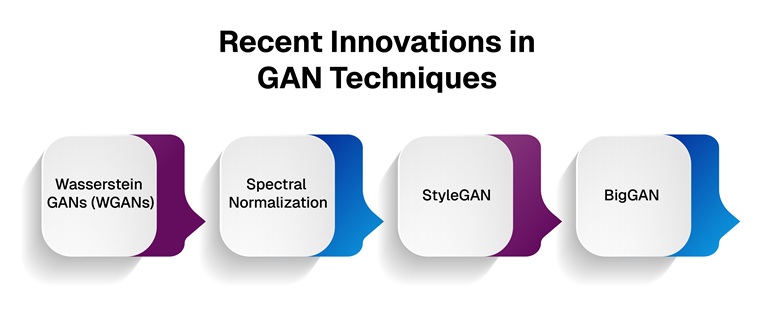
Recent Innovations in GAN Techniques

The journey from basic GANs to current sophisticated models has seen numerous innovations. Several breakthrough improvements have enhanced performance and stability across the field.

Recent Innovations in GAN Techniques
  • Wasserstein GANs (WGANs): Wasserstein GANs address one of the biggest challenges in GAN training: instability. Traditional GANs often struggle with unstable training that can result in the Generator producing nonsensical outputs. WGANs use the Wasserstein distance as a loss function, providing more stable and meaningful gradients for training the Generator. This innovation has made GAN training significantly more reliable.
  • Spectral Normalization: Spectral Normalization represents another major advancement. This technique normalizes the weights of the Discriminator to ensure gradient magnitudes remain consistent, further stabilizing the training process. This helps prevent the wild oscillations that plagued earlier GAN implementations.
  • StyleGAN: StyleGAN emerged as a game changer for generating high resolution, high quality images. Developed by NVIDIA, StyleGAN allows better control over both the style and structure of generated images. This makes it particularly valuable in synthetic media creation where precise control over output characteristics is essential.
  • BigGAN: BigGAN models pushed boundaries by generating highly detailed images using larger model sizes and more computational resources. BigGANs leverage class conditional generation to create diverse and realistic samples that were previously impossible to achieve.

Conditional GANs: Adding Contro

Standard GANs generate random outputs from learned distributions, but many applications require more control. Conditional GANs (cGANs) extend the original framework by conditioning both the Generator and Discriminator on additional information such as class labels. This allows for targeted and controlled data generation.

CycleGANs take this concept further by enabling image to image translation without paired examples. CycleGANs use cycle consistency to ensure that an image translated to another domain and back remains unchanged. This enables impressive applications like converting photographs into paintings and vice versa.

Practical Applications Transforming Industries

GAN applications have moved far beyond academic research into practical real world uses. GANs are widely used for tasks like image synthesis, data augmentation, and speech enhancement, especially when high quality labeled training data is limited.

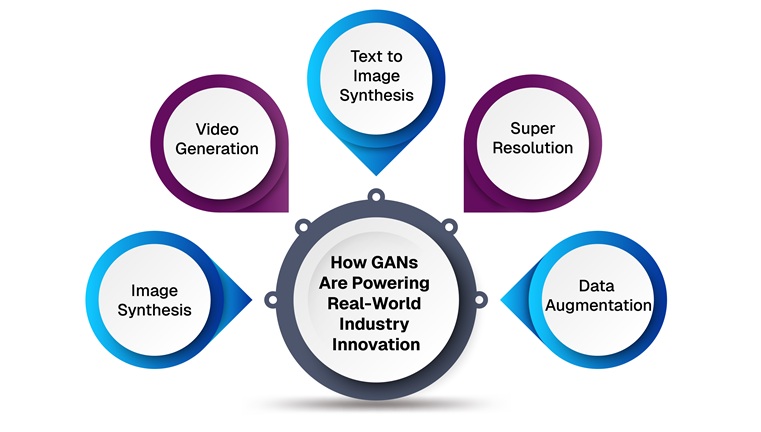
How GANs Are Powering Real-World Industry Innovation
  • Image Synthesis: Image Synthesis represents one of the most visible GAN applications. DeepFakes demonstrate the power of GANs in creating realistic videos and images. While controversial due to potential misuse, they showcase how far image generation technology has advanced. Artists and designers use GANs to create unique artwork by learning from vast datasets and producing original creations that blend styles in novel ways.
  • Video Generation: Video Generation has benefited significantly from GAN techniques. Motion transfer allows GANs to generate videos by transferring motion patterns from one source to another. For example, making a still image of a person dance by learning from video of another person dancing. Video prediction uses GANs to anticipate future frames in a sequence, with applications in robotics and autonomous driving where predicting future movements is crucial.
  • Text to Image Synthesis: Text to Image Synthesis bridges language and visual content. OpenAI's DALL-E serves as a prime example, generating images from textual descriptions. This technology proves particularly useful in creative industries and marketing where visual content needs to match specific descriptions. AttnGAN enhances this further by incorporating attention mechanisms, ensuring generated images accurately reflect details described in input text.
  • Super Resolution: Super Resolution allows GANs to upscale low resolution images to high resolution versions. This improves image quality in fields like medical imaging and satellite photography where detail matters enormously.
  • Data Augmentation: Data Augmentation addresses a common machine learning challenge: insufficient training data. GANs generate synthetic data to augment training datasets, improving model robustness and performance in situations where real data is scarce. This capability makes GANs especially valuable when obtaining labeled training data is difficult or expensive.

Advantages That Set GANs Apart

Several key advantages make GANs powerful tools for AI and machine learning. GANs can generate high quality images that look realistic to humans. They excel at generating diverse data samples, helpful for training machine learning models that need to handle variety.

GANs are relatively easy to train compared to some alternatives, and they often converge faster than other types of generative models. perhaps most importantly, GANs have potential to learn from data with little or no label information, making them useful for unsupervised learning tasks where labeled data is unavailable.

Challenges Requiring Solutions

Despite their successes, GANs come with significant challenges. Major challenges require ongoing research attention to overcome persistent limitations.

  • Training Instability remains a persistent issue. GAN training can be highly unstable, often resulting in the Generator producing nonsensical outputs. This instability arises from the delicate balance required between Generator and Discriminator during training.
  • Mode Collapse occurs when the Generator produces a limited variety of outputs, failing to capture the full diversity of the target data distribution. This happens when the Generator finds a narrow range of outputs that consistently fool the Discriminator but does not represent the full data distribution.
  • Evaluation Metrics present another challenge. Unlike supervised learning models where accuracy can be measured directly, GANs require more nuanced metrics like Inception Score and Fréchet Inception Distance (FID) to assess the quality and diversity of generated samples.

Training GANs involves having two neural networks compete against each other, one to generate fake data and one to identify fake data. As networks train, the generator improves at creating fake data that is hard to distinguish from real data, while the discriminator improves at identifying fakes. This competitive process, while powerful, introduces complexity that makes training challenging.

Advanced Architecture Developments

Beyond basic improvements, sophisticated architectural innovations have emerged. Deep Convolutional GANs (DCGANs) successfully designed a class of architecturally constrained networks that show substantial advancements in unsupervised image representation learning with more stable training and superior quality images. The architectural changes include using strided convolutions and fractional strided convolutions instead of pooling layers, exploiting batch normalization in both Generator and Discriminator, and removing fully connected hidden layers for deep architectures.

Progressive GANs introduced a novel training strategy where low resolution images are passed as input and then resolution is increased gradually by adding layers at each stage. This allows learning of large scale structure of the image distribution first and then other finer details. New layers are faded in smoothly to avoid unexpected shocks to well trained, smaller resolution layers.

Energy based GANs (EBGAN) replaced the standard Discriminator with an autoencoder architecture where the Discriminator assigns low energy to training data while high energy to samples generated by the Generator. This approach models an energy surface where preferred patterns get assigned low energies and undesirable patterns are assigned high energies, creating more stable training conditions.

Future Directions in Research

The future of GAN research looks promising with several exciting directions on the horizon. Developing new algorithms and training techniques to enhance stability remains a top priority. Innovations like WGANs and spectral normalization represent steps in the right direction, but more robust solutions are needed.

Scalability represents another key focus area. Scaling GANs to handle larger datasets and more complex tasks involves optimizing computational resources and developing architectures that can efficiently process vast amounts of data.

Ethical Considerations become increasingly important as GANs grow more powerful. Ensuring responsible use of GAN technology, particularly in areas like DeepFakes, is crucial to prevent misuse and maintain public trust in AI.

Conclusion

Generative Adversarial Networks have undoubtedly transformed the landscape of AI and machine learning. From their innovative architecture to their wide range of applications, GANs represent a significant leap forward in our ability to generate and manipulate data. Although GANs are still in early developmental stages, they have already shown great potential for the future of data generation and analysis.

The ability to generate realistic datasets has many potential applications in fields such as healthcare, finance, and manufacturing. With continued development, GANs may soon become an essential tool for businesses and researchers alike. As we look to the future, the potential for GANs to revolutionize industries and improve lives remains immense. While challenges persist, ongoing research and advancements continue pushing the boundaries of what GANs can achieve.

Follow Us!

Conversational Ai Best Practices: Strategies for Implementation and Success
Artificial Intelligence Certification

Contribute to ARTiBA Insights

Don't miss this opportunity to share your voice and make an impact in the Ai community. Feature your blog on ARTiBA!

Contribute