The exponential growth of Ai technologies like machine learning, deep learning, and natural language processing over the past decade has led to their widespread adoption across industries. As organizations increasingly rely on Ai to drive critical business decisions and workflows, ensuring the security of these systems has become a pivotal concern.
This article explores the emerging threat landscape that accompanies the rise of Ai and provides guidelines on how to build secure environments for developing, training, and deploying Ai models.
The raрid exрansion of Ai models into рroduction environments has considerably exрanded the attack surface available for malicious actors. Internet-facing APIs serving Ai model inferences present new targets. The data pipelines feeding these models also increase exposure. Since the accuracy of Ai systems relies heavily on large swathes of quality data, threats like data poisoning can severely impact their reliability. As organizations adopt Ai to handle sensitive tasks, like providing financial advice or powering healthcare diagnosis, ensuring the integrity and resilience of these systems against adverse security events becomes critical.
Apart from traditional vectors like networks, servers, and user devices, attackers can now exploit weaknesses in the Ai algorithms themselves. Vulnerabilities native to machine learning systems, like adversarial samples, backdoors, model stealing, and more, allow adversaries to manipulate model behavior or performance. If compromised, the high-stakes decisions delegated to Ai can have damaging consequences that undermine public trust. As Ai capabilities continue advancing into socially sensitive domains, the imperative for Ai security heightens.
While traditional cyber threats still apply to Ai environments, systems incorporating machine learning, deep learning, and natural language processing face additional risks that can uniquely subvert their functionality. Some key threats include:
Evasion Attacks: Carefully engineered inputs can induce Ai models to make incorrect predictions during inference. For instance, adding imperceptible perturbations to an image can cause a classifier to misidentify objects within it completely. Attackers can leverage this to bypass Ai-powered detection systems.
Data Poisoning: Intentionally corrupting the dataset used to train models can manipulate their behavior as per the attacker’s objectives. For example, introducing mislabeled examples during training can degrade classification accuracy or cause biased outcomes.
Model Extraction: By observing a model’s inputs and outputs, adversaries can reconstruct its behavior using machine learning techniques. Attackers can steal proprietary models to extract intellectual property or find weaknesses.
Backdoor Attacks: Attackers can sabotage models by poisoning training data to include malicious triggers. Models affected by such backdoors behave normally unless the trigger is present in the input. This allows attackers to activate the backdoor to force undesirable outcomes.
Adversarial Ai: Attackers can train models specifically optimized to target and subvert Ai systems using adversarial techniques tailored to machine learning. This can lead to an “arms race” requiring constant system updates to maintain resilience.
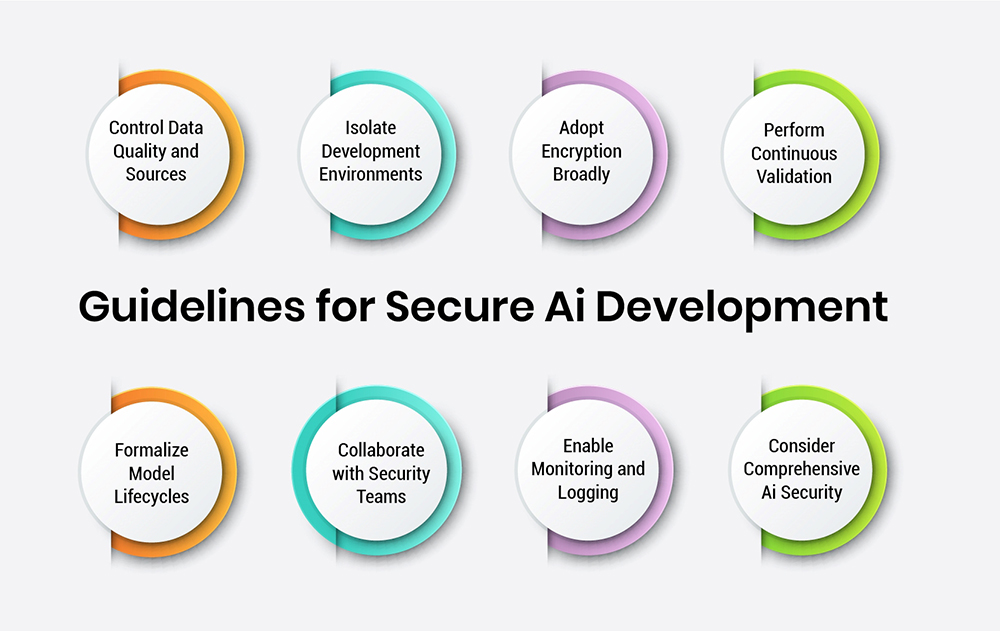
Organizations leveraging Ai to solve complex problems must prioritize security in their development pipelines to prevent adversarial interference. Some key guidelines include:
Control Data Quality and Sources: Scrutinize all data sources feeding into development and continuously monitor pipelines for integrity. As data forms the foundation for reliable Ai, securing it is vital for trustworthy systems.
Isolate Development Environments: Sandbox Ai workloads within controlled environments with lockdown access policies instead of developing on production infrastructure. This limits external interference during development.
Adopt Encryption Broadly: Encrypt data flows, model artifacts, user communications, and stored assets throughout the pipeline. This protects confidentiality and integrity across the stack.
Perform Continuous Validation: Continuously monitor models with techniques like anomaly detection to spot degrading performance that indicates potential manipulation. Keep systems updated to detect emerging attack patterns.
Formalize Model Lifecycles: Institute rigorous model version control, testing, risk assessment, and deployment policies that align with industry standards for enterprise software. Treat Ai models as mission-critical code.
Collaborate with Security Teams: Seek guidance from security engineers to audit systems and harden infrastructure against both conventional attacks and Ai-specific threats during development. Make security a shared responsibility.
Enable Monitoring and Logging: Incorporate robust logging for system telemetry and ensure visibility into all Ai components for efficient auditing, forensics, and attack investigation after deployment.
Consider Comprehensive Ai Security: Evaluate enterprise-grade Ai cybersecurity platforms with capabilities spanning data governance, model and infrastructure protection, monitoring, access control, and more for end-to-end security.
To embed security into the Ai model development lifecycle, robust platform capabilities for development teams paired with hardened infrastructure for deploying and serving models in production is key. Some critical components include:
Identity and Access Management: Enforce access controls, multi-factor authentication, single sign-on, and protocols like Security Assertion Markup Language amongst users and services interacting with Ai systems.
Data Encryption: Implement transport and storage encryption mechanisms providing data security throughout pipelines.
Environment Isolation: Containerize workloads and integrate technologies like virtual private clouds to create isolated environments for Ai. Restrict external access.
Continuous Security Validation: Build instrumentation into the CI/CD pipeline, implementing static analysis, sandbox testing, adversarial assessment, etc., to validate model integrity pre and post-deployment.
Anomaly Detection: Analyze system telemetry, data drift across trains-test splits, and model performance drift to detect anomalies indicating potential manipulation.
Network Security: Adopt micro-segmentation, packet inspection, intrusion prevention systems, and next-gen firewalls to secure network traffic-driving Ai models
As organizations operationalize Ai, new attack vectors ripple across the IT environments. Security strategies must extend beyond infrastructure to the very data science powering competitive advantages. This makes sectoral nuances pivotal in planning Ai model security.
Ai applications in healthcare aim to augment human expertise with data-driven insights for diagnosis and treatment. Adoption focuses on precision medicine, clinical decision support, and patient profile analysis.
However, these systems ingest sensitive medical data. Attackers can target hospitals’ Ai infrastructure to steal records for identity theft via techniques like model extraction. Patient privacy is also at stake if de-anonymization vulnerabilities exist.
For healthcare Ai deployment, security priorities include:
Data governance per healthcare regulations
Anonymization techniques that balance utility and privacy
Differential privacy and federated learning for decentralized data use
Institutional finance leverages Ai for everything from predictive analytics in quantitative trading to anti-money laundering transaction monitoring. Both proprietary data, like trading algorithms and sensitive client information, are goldmines for attackers. Insider threats are also a concern.
Priorities for securing finance Ai include:
Encryption and access controls for financial data
Sandboxed development environments
Cybersecurity compliance measures like SOX
Surveillance systems to detect insider threats
Ai and ML drive advancement in autonomous vehicles, ADAS systems, and EV battery optimization. However, internet-connected cars also increase the surface of attacks for manufacturers.
Key focus areas for automotive Ai security include:
Isolating safety-critical systems
Ensuring the reliability of sensor data and models
Fleet cybersecurity monitoring
Protection against IP theft targeting proprietary designs
Retailers utilize Ai for streamlining supply chains, optimizing marketing campaigns and providing personalized recommendations to boost sales. However, these data-heavy initiatives also require robust data governance.
For retail Ai security, the key requirements are:
Secure and ethical data collection practices
Surveillance against insider threats and leaks
Governance policies that respect user privacy
Testing model behavior to prevent bias or manipulation
5G and the scale of modern networks have made Ai-driven network optimization indispensable for telecoms. They also utilize AI to improve customer experiences via intelligent chatbots and marketing.
Priority areas for securing telecom Ai include:
Ensuring the resilience of network infrastructure
Safeguarding subscriber data
Preventing service disruption via network-level security
Ethical standards for user engagement
Energy utilities apply Ai to forecast demand, predict renewable output, and schedule maintenance. However, threat actors can target weaknesses in these systems to trigger blackouts.
Areas of focus for energy Ai security include:
Protection of critical infrastructure
Resilience testing under simulated attack conditions
Anomaly detection in infrastructure data flows
Ai guides quality control, predictive maintenance, and inventory automation in smart factories. But lax security exposes industrial secrets and intellectual property around proprietary processes.
Manufacturing Ai security requires:
Zero trust architectures to prevent IP theft
Validation of sensor data feeding decisions
Controlling partner and supplier ecosystem access
Agriculture leverages Ai for monitoring crop health, optimizing inputs like water or fertilizer and predicting yields. But despite the sector’s digital transformation, cybersecurity readiness lags.
Priorities for securing agriculture Ai include:
Governance policies for agritech vendors
Farmer education on new cyber risks with Ai adoption
Monitoring the integrity of agronomic data
While the security challenges manifest differently across sectors, ultimately, organizations must align objectives, budgets, and talent to manage emerging risks. The costs of ignoring these sectoral nuances are profound.
As Ai becomes ubiquitous across business and society, securing its development, deployment and operation constitutes an immense shared responsibility for organizations leveraging its potential while ensuring public interests are safeguarded.
Integrating security into the Ai journey demands meaningful collaboration between development teams and cybersecurity leadership, where sustainable and scalable measures emerge through a unified strategy.
With cyber threats targeting Ai inevitable, getting ahead requires enterprise-wide participation, investment, and oversight in cyber-resilient Ai models that balance innovation with trust.
Don't miss this opportunity to share your voice and make an impact in the Ai community. Feature your blog on ARTiBA!
Contribute