Essential Deep Learning Algorithms for Artificial Neural Networks

Essential Deep Learning Algorithms for Artificial Neural Networks
March 22, 2024

Deep learning has transformed fields like computer vision, speech recognition, natural language processing, and more by enabling unprecedented levels of automation and accuracy. At the core of deep learning are artificial neural networks - computing systems inspired by the neural networks in the human brain.

In order to leverage the full power of deep learning, it's important to understand some of the key algorithms artificial neural networks use. This article will provide an overview of essential deep learning algorithms that enable today's state-of-the-art artificial intelligence.

What is Deep Learning?

Deep learning is а subset of machine learning based on artificial neural networks, with 'deep' referring to the multiple layers in these neural networks. While conventional machine learning algorithms are limited to relatively superficial analysis, deep learning models can extract richer, more abstract representations from large and complex datasets like images, text, and audio. This is achieved by passing data through many successive non-linear transformations within а neural network. Deep learning underpins today's rapid advances in areas like computer vision, speech recognition, natural language processing, and artificial intelligence.

Neural Networks and Deep Learning

Artificial neural networks are computing systems consisting of densely interconnected nodes like neurons in the brain. They are organized into layers that transform input data into different representations by weighting inputs, calculating sums, and applying non-linear activation functions until an output is produced.

Deep learning uses neural networks with many hidden layers, enabling them to model highly complex relationships in data. The additional layers empower deep learning algorithms to extract meaningful features from raw, unstructured data to perform accurate analysis and predictions.

Top Deep Learning Algorithms

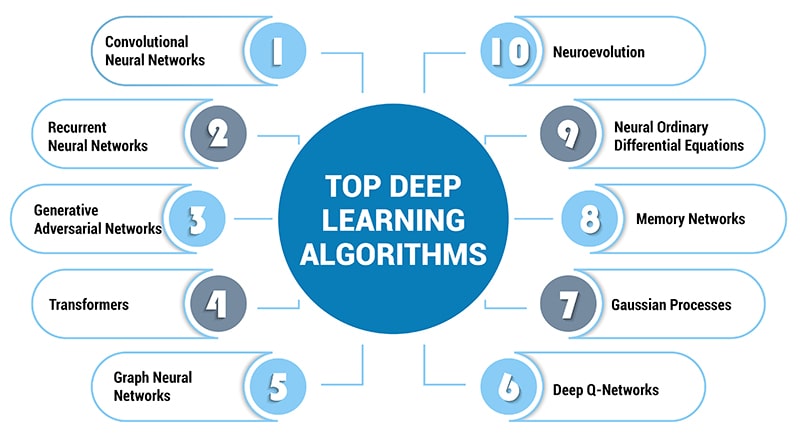
Many different algorithms for training deep neural networks have been developed, each with advantages for certain applications. Here are some of the most important deep learning algorithms driving today's artificial intelligence.

Inspiring Women Shaping the Future of Ai, Machine Learning, and Robotics
  • Convolutional Neural Networks: Convolutional neural networks (CNNs or ConvNets) revolutionized image recognition through their superior ability to learn visual features automatically from pixel data. They utilize а special architecture, including convolutional layers that apply filters across images to extract patterns and features.

    Pooling layers reduce the size of feature maps while retaining important information. Fully connected layers at the end classify images based on the learned features. CNNs achieved breakthrough results in computer vision and remain essential for image and video recognition.

  • Recurrent Neural Networks: While CNNs excel with spatial data like images, recurrent neural networks (RNNs) are designed for sequential data like text or audio where context is important. RNNs utilize cyclical connections that enable data persistence across time steps. This gives them short-term memory, letting them learn temporal relationships.

    Different RNN architectures like long short-term memory networks (LSTMs) and gated recurrent units (GRUs) overcome vanishing gradients, enabling RNNs to model longer sequences for use cases ranging from language translation to speech recognition.

  • Generative Adversarial Networks: Generative adversarial networks (GANs) involve two neural networks contesting with each other to become skilled at generating new synthetic data resembling some known training data. They implicitly learn to model target distributions without encountering overfitting issues faced by other generative models.

    Researchers demonstrated GANs could generate realistic handwritten digits and high-resolution celebrity faces. Modern conditional GANs can also produce data adhering to arbitrary styles or categories when conditioned using additional information like class labels or text.

  • Transformers: Transformers introduced the transformer architecture that eschewed recurrence and relied completely on an attention mechanism to learn relationships between sequence elements based on their global significance. Researchers applied transformers to natural language processing, achieving state-of-the-art results in machine translation, text classification, and language modeling with models like Google's BERT and OpenAI's GPT-3. The transformer paradigm made significant contributions in enabling deep learning models to better process language data.

  • Graph Neural Networks: While many neural networks process Euclidean data like images or text, graph neural networks are specifically designed to process graph data with complex relationships between elements. They generalize convolutional network approaches like filtering to graph-structured data and learn distributed representations of nodes based on graph topology and node attributes.

    Graph neural networks demonstrated high accuracy at tasks like link prediction, node classification, and community detection within networks. They show promise for use cases involving highly relational data.

  • Deep Q-Networks: Deep Q-networks (DQNs) drove breakthroughs in using deep reinforcement learning to master complex games. DQNs employ neural networks as function approximators to estimate quality value (Q) functions that determine optimal actions, maximizing expected rewards.

    Nvidia researchers combined CNNs and Q-learning into DQNs that delivered human-level gameplay across many Atari 2600 games. DeepMind later used DQNs to achieve superhuman gameplay in 3D games and master the game of Go. DQNs remain widely used within deep reinforcement learning.

  • Gaussian Processes: While most deep learning approaches perform discriminative learning to model conditional probabilities of outputs given inputs, Gaussian processes can perform probabilistic regression modeling to predict continuous variables directly. They model distributions over functions based on sets of observations and provide uncertainty estimates regarding predictions.

    Gaussian processes are highly flexible for applications like black-box optimization as well as visualizing model uncertainty. When combined with neural networks in hybrid approaches, Gaussian processes enhance predictive capabilities.

  • Memory Networks: Memory networks incorporate external memory modules storing large memories as explicit knowledge bases that deep learning models can read from and write to via attention mechanisms. They provide models with the capacity to quickly encode and retrieve knowledge like facts.

    Researchers applied memory networks to natural language processing for low-shot learning and question answering where training examples are scarce but external knowledge is available. This architecture demonstrates how memory components can substantially improve language understanding.

  • Neural Ordinary Differential Equations: While most deep learning approaches apply discrete operations like matrix multiplication, neural ordinary differential equations treat entire deep neural networks as continuous dynamical systems modeled by differential equations. This framework enables the adaptation of computational expense to network depth and the application of ODE solvers for improved efficiency and accuracy.

    Neural ODEs merge machine learning approaches with traditional numerical methods for modeling dynamical systems. They could enable new ways of designing, analyzing, and optimizing neural network models.

  • Neuroevolution : Rather than manually specifying neural network architectures and hyperparameter values, neuroevolution automatically searches for ideal models using evolutionary algorithms through generations of selective reproduction with mutation. Strong designs persist while weaker ones perish.

    At Uber, researchers evolved LSTM architectures using neuroevolution that achieved state-of-the-art results in time series forecasting. The automated design process lowers manual effort and introduces architectural innovations humans could overlook. Mating compatible solutions via crossover also combines beneficial genetic material for superior performance.

The Road Ahead

As deep learning advances, researchers will continue developing new algorithms and architectures to expand capabilities, efficiency, and scalability. Expanding distributed and multi-agent approaches will also enable coordinating specialized modules with shared representations and memories.

Groups of learning algorithms will likely combine strengths to achieve more sophisticated intelligence. Further integration with other branches of Ai could ultimately lead to artificial general intelligence with capabilities rivaling or exceeding human-level comprehension. Powerful deep learning algorithms will remain essential building blocks driving progress towards that goal.

Follow Us!

2nd International Conference on Artificial Intelligence and Data Science
Conversational Ai Best Practices: Strategies for Implementation and Success
Artificial Intelligence Certification

Contribute to ARTiBA Insights

Don't miss this opportunity to share your voice and make an impact in the Ai community. Feature your blog on ARTiBA!

Contribute