Responsible AI for Sustainable Development: UNESCO’s Key Principles

The International Day of Engagement in Science for Sustainable Development, observed on November 27, highlights the role of science and public participation in building a sustainable, inclusive, and resilient future. Proclaimed by UNESCO’s General Conference in 2025, the day recognizes science as a common good and encourages greater public involvement in scientific progress.
Artificial intelligence (AI) can contribute to this progress, but its benefits depend on how organizations develop and use it. According to PwC’s 2025 Value in Motion research, AI has the potential to increase global economic output by up to 15 percentage points over the next decade, equivalent to adding approximately one percentage point to annual global economic growth. The research also presents more conservative scenarios, estimating an additional economic boost of 8% under lower-trust conditions and just 1% under a pessimistic scenario. More recently, IDC’s June 2026 research projected that AI could generate USD 22.5 trillion in cumulative economic value between 2025 and 2031 under its baseline scenario. This estimate includes direct AI revenues, supply chain effects, and economic activity resulting from productivity gains. These projections highlight AI’s economic potential, but realizing its benefits requires organizations to consider more than productivity and revenue. They must also address environmental costs, unequal access, discrimination, and accountability.
Responsible AI provides a framework for managing these concerns. UNESCO’s Recommendation on the Ethics of Artificial Intelligence offers internationally recognized principles that engineers, businesses, and policymakers can apply throughout the AI lifecycle.
The UNESCO Framework in Plain Terms
In November 2021, UNESCO’s General Conference adopted the Recommendation on the Ethics of Artificial Intelligence, the first global standard on AI ethics. It provides guidance for governments, businesses, researchers, and other stakeholders.
The framework rests on four core values: respect for human rights and dignity, environmental and ecosystem protection, diversity and inclusion, and peaceful, just, and interconnected societies.
These values are translated into ten core principles that guide the responsible development and use of AI. They address proportionality and safety, fairness and non-discrimination, sustainability, privacy and data protection, human oversight and determination, transparency and explainability, accountability, public awareness and literacy, multi-stakeholder and adaptive governance, and protection of the environment and ecosystems.
Counting the Environmental Cost Across the AI Lifecycle
UNESCO’s sustainability principle calls for assessing AI systems against broader sustainability goals, including the United Nations Sustainable Development Goals (SDGs). Its Recommendation asks organizations to consider environmental effects throughout the AI lifecycle, including energy consumption, carbon emissions, and the extraction of raw materials used in hardware.
For engineers, sustainable AI development starts with measurement. They should consider how much energy training consumes, where the electricity comes from, how often a model needs retraining, and whether a smaller model could perform the same task. Water consumption, cooling requirements, hardware production, and electronic waste also belong in the assessment.
A 2025 study published in Nature Sustainability estimated that AI server deployment in the United States could generate 731 million to 1,125 million cubic meters of annual water footprint and 24 million to 44 million metric tons of additional annual carbon dioxide-equivalent emissions between 2024 and 2030. The researchers also found that industry best practices could reduce emissions by up to 73% and water footprints by up to 86%. These are projections, and infrastructure limitations could restrict the reductions.
Environmental monitoring should continue after deployment. Training a model consumes computing resources, but inference (the process of using a trained model to generate outputs) creates repeated energy demand as people use the system.
Google provides an example of how companies can measure this impact. In August 2025, it estimated that a median text prompt in Gemini Apps used 0.24 watt-hours of energy, produced 0.03 grams of carbon dioxide equivalent, and consumed 0.26 milliliters of water. Google also reported that improvements to its models, hardware, and infrastructure reduced the energy footprint of a median text prompt by 33 times and its carbon footprint by 44 times over a recent 12-month period. These are company-reported estimates based on Google’s methodology, not universal figures for all AI services.
AI can also contribute directly to environmental protection. The UNDP Accelerator Labs use satellite and drone imagery to identify crop diseases in Cameroon and Cabo Verde and detect accumulated waste in Guatemala, the Philippines, Serbia, and Vietnam. They also use Earth observation data for land-use and land-cover mapping in Ecuador and India.
Another example comes from Bangladesh. A climate adaptation pilot under the UK- and Canada-supported Climate Adaptation and Resilience (CLARE) programme uses AI-based forecasting to improve storm preparedness in coastal communities. During Cyclone Remal in 2024, the project identified 30 embankment locations at risk, helping communities mobilize resources and strengthen vulnerable areas. The cyclone displaced more than 120,000 people. AI’s value in climate adaptation depends on effectively delivering actionable insights to vulnerable communities.
Fairness Starts With Who Has Access
Access to AI resources and benefits varies significantly across regions and demographics. Differences in computing infrastructure, technical skills, data availability, and investment can limit the ability of developing countries and underserved communities to participate in AI development.
A September 2026 UN report on AI capacity-building highlighted this infrastructure gap. High-income countries accounted for 77% of global co-location data center capacity in June 2025, while low-income countries accounted for less than 0.1%. These figures show why equitable access to computing infrastructure must be part of responsible AI discussions.
Fairness also concerns how individual systems treat people. A hiring or credit model may achieve strong overall accuracy while producing less reliable outcomes for particular demographic groups. Engineers should therefore examine performance across relevant groups rather than relying only on overall scores.
Research highlighted by Stanford illustrates this risk. A study examining 4 million job applications from 3.4 million people, covering 1,700 job postings across 150 employers, found racial disparities in AI-based hiring recommendations. It reported that 26% of Black applicants and 15% of Asian applicants applied to positions where the AI system discriminated against their racial group. The researchers estimated that approximately 40,000 additional applications from Black and Asian candidates could have advanced if they had received recommendations at the same rate as the most-favored group.
Engineers need representative datasets, group-level performance testing, and regular audits. Business leaders should also require vendors to provide enough information to evaluate their systems and establish procedures for reviewing disputed decisions.
Making AI Systems Auditable and Understandable
Responsible AI requires organizations to explain how systems work, identify who is accountable for their outcomes, and provide ways to investigate harmful decisions.
UNESCO’s accountability principle calls for AI systems to be auditable and traceable. Its Recommendation also supports ethical impact assessments, oversight, and due diligence throughout the AI lifecycle.
For engineers, auditability begins with maintaining records of data sources, model versions, training processes, testing results, and significant design decisions. These records help reviewers investigate how a system produced an output and identify where problems occurred.
Transparency should reflect the consequences of a decision. A music recommendation may need only a brief explanation, while a loan rejection, medical recommendation, or employment decision requires more meaningful information. People affected by consequential decisions should understand AI’s role and know how to request a review.
Human oversight is equally important. AI systems can produce incorrect or misleading outputs, so organizations should define when a person must review a result, override a recommendation, or stop a system.
A 2025 UN Department of Peace Operations survey found that 68% of peacekeepers said misinformation and disinformation had a moderate to severe effect on their peace and security work. Another 76% said these problems affected their safety and security. These findings demonstrate why information literacy and reliable communication are important, particularly in environments where misleading content can put people at risk.
What AI Engineers Can Apply
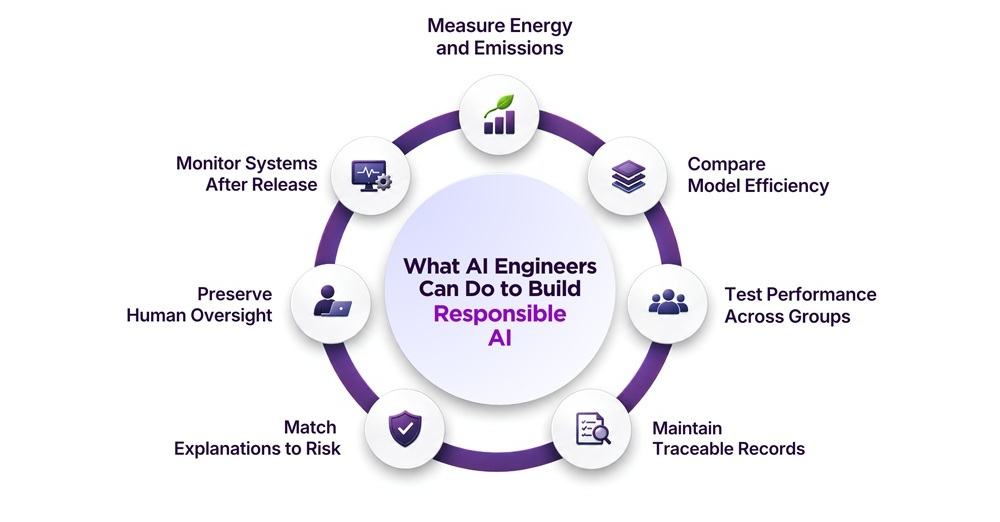
Engineers can implement responsible AI principles through technical practices by integrating environmental measurement, fairness testing, documentation, and human oversight into development and deployment workflows.
Practical steps include:
-
Measure energy and emissions: Record energy consumption for training and inference workloads. Estimate associated emissions where possible.
-
Compare model efficiency: Test whether smaller models, efficient architectures, or less frequent retraining can meet performance requirements with fewer resources.
-
Test performance across groups: Evaluate accuracy, error rates, and outcomes across relevant demographic and geographic groups.
-
Maintain traceable records: Document data sources, model versions, evaluation results, and design decisions.
-
Match explanations to risk: Provide meaningful explanations for high-impact decisions involving employment, credit, healthcare, and public services.
-
Preserve human oversight: Establish clear review and override procedures for consequential decisions.
-
Monitor systems after release: Track model drift, unexpected outputs, security issues, complaints, and environmental performance.
What Business Leaders Can Apply
Business leaders determine which AI systems an organization develops, how much it invests, and what safeguards are required. Responsible AI therefore needs executive ownership, clear policies, and measurable objectives.
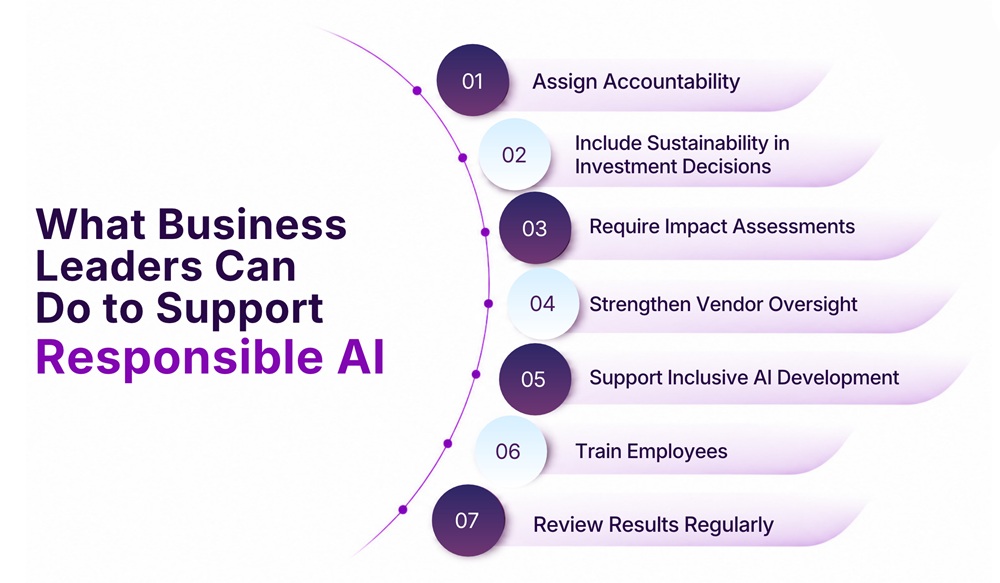
Leaders can take several practical steps:
-
Assign accountability: Name an owner for each high-impact AI system and define responsibilities across technical, legal, operational, and business teams.
-
Include sustainability in investment decisions: Evaluate energy consumption, emissions, water use, hardware requirements, and electronic waste alongside financial returns.
-
Require impact assessments: Review potential effects on human rights, privacy, fairness, employment, and the environment before deployment.
-
Strengthen vendor oversight: Request information about training data, model limitations, security, environmental performance, and independent evaluations.
-
Support inclusive AI development: Invest in skills, relevant datasets, affordable computing, and local-language resources in the markets where the organization operates.
-
Train employees: Help staff understand AI limitations, question unreliable outputs, protect sensitive information, and report concerns.
-
Review results regularly: Monitor whether systems meet their intended goals and create unintended consequences.
Capacity-building is particularly important for countries with limited AI infrastructure. In September 2026, a UN Secretary-General’s report recommended advancing the establishment of a Global Fund for AI Capacity-Building. It suggested an indicative initial funding range of USD 3 billion over two to four years. This is a proposal, not money already raised or committed. The proposed fund would help address gaps in computing infrastructure, energy, connectivity, data, and skills.
Turning November 27 Into a Working Session
The International Day of Engagement in Science for Sustainable Development encourages dialogue between scientists, policymakers, businesses, and the public. Organizations can use the occasion to examine how their AI systems affect people and the environment.
A practical starting point is to select one AI system and review it against UNESCO’s principles. A working group can examine its purpose, data sources, energy requirements, performance across user groups, security measures, and human oversight arrangements.
The team can then prepare a plain-language summary explaining what the system does, how it uses data, what its limitations are, and how people can challenge its decisions. Where appropriate, organizations can invite employees, customers, researchers, and community representatives to review the findings.
The review should lead to measurable actions, such as reducing unnecessary model calls, improving performance for an underrepresented group, documenting automated decisions, or introducing a human review process.
Responsible AI requires ongoing evaluation, transparent decision-making, and active participation from the people affected by AI systems. A policy statement or one-time assessment alone cannot ensure responsible AI practices. By applying UNESCO’s framework to everyday engineering and business decisions, organizations can use AI to support sustainable development while taking responsibility for its environmental and social consequences.