AI Science Diplomacy: How the UN Is Shaping Global AI Governance
November 10 is World Science Day for Peace and Development. In 2026, its theme is “Common ground through science diplomacy,” highlighting how scientific cooperation can help countries address shared challenges despite differences in their interests, resources, and priorities. Artificial intelligence (AI) is one such challenge.
AI capabilities are advancing quickly, and countries differ in their access to AI research, computing infrastructure, technical expertise, and data. These differences affect their ability to develop and evaluate AI systems. Without a shared understanding of technology, governments may approach similar risks differently, while countries with fewer resources have less influence over international discussions.
The United Nations is addressing this gap through two connected initiatives established by General Assembly Resolution A/RES/79/325, adopted on August 26, 2025. The Independent International Scientific Panel on AI assesses scientific evidence about AI’s opportunities, risks, and impacts. The Global Dialogue on AI Governance brings governments and other stakeholders together to discuss that evidence and its implications.
Together, they offer a practical example of science diplomacy, i.e., independent research informs international discussion, while countries retain the responsibility to decide how they approach AI governance.
How the UN Is Connecting Scientific Evidence with Global Dialogue
The Independent International Scientific Panel on AI is the first global scientific body dedicated entirely to AI. Its 40 members were appointed in February 2026 following an open selection process that attracted more than 2,600 applications from over 140 countries. They represent all five UN regions and bring expertise from academia, the private sector, civil society, and the technical community.
At its inaugural meeting on March 3, 2026, the Panel elected Yoshua Bengio, a 2018 Turing Award recipient, and Maria Ressa, a Nobel Peace Prize laureate and journalist, as co-chairs.
The Panel works independently. Its members serve in their personal capacities and do not accept instructions from governments or other organizations. Its mandate includes producing annual evidence-based assessments, preparing thematic briefs, and presenting its findings to the Global Dialogue. It does not regulate AI or enforce standards. The Panel’s official FAQ explains its independence and relationship with the Dialogue.
This separation matters. Scientific assessments can identify what research demonstrates, where findings remain uncertain, and which risks deserve further investigation. Governments and stakeholders can then consider the implications without treating the scientific report as a binding policy decision.
The Panel released its Preliminary Report on July 1, 2026. It examines AI developments and their implications across areas including science, health, education, agriculture, the economy, security, human rights, democracy, and governance. The report is available in all six official UN languages, helping make its findings accessible to countries and stakeholders with different levels of technical capacity.
The Geneva Dialogue: A Shared Evidence Base for Different Countries
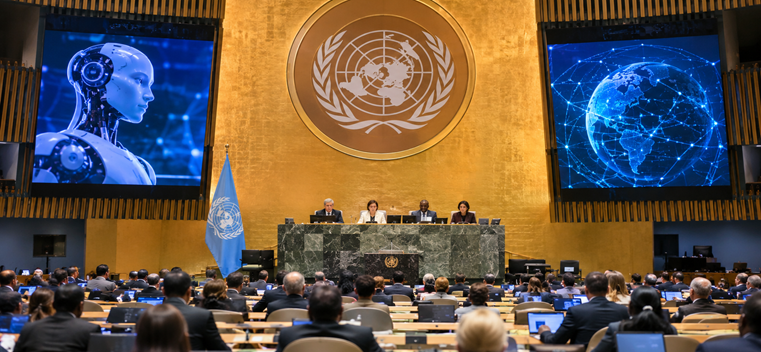
The first Global Dialogue on AI Governance took place in Geneva on July 6 and 7, 2026. It brought governments together with representatives from the private sector, civil society, academia, and the technical community.
According to the UN’s official FAQ, the first Dialogue brought together more than 3,000 participants, including delegations from 163 countries. These figures refer to registration and reported participation, respectively.
The Dialogue followed an eight-month preparatory process that received 1,532 unique written submissions from organizations and individuals across all regional groups.
The Panel’s Preliminary Report informed the discussions. This connection between scientific assessment and multilateral dialogue is central to the model, countries can examine a common evidence base even when they have different political priorities, technological capabilities, and regulatory approaches.
The Dialogue supports exchanges on AI governance and concludes with a co-chair summary. Its discussions do not constitute negotiations or binding agreements. It provides a common starting point for discussions of AI governance issues that cross national borders.
Why Shared Evidence Matters: Language, Access, and AI Risks
Science diplomacy becomes meaningful when evidence reflects. Scientific assessments should consider how AI affects countries and communities with different languages, resources, and technical capabilities.
A Microsoft Research paper, BYOL: Bring Your Own Language into LLMs, published in October 2026, examines ways to adapt large language models (LLMs) for languages with limited digital resources. Its framework produced improvements for languages including Chichewa and Māori across a set of benchmarks. For Inuktitut, a translation-mediated approach improved performance over a commercial baseline.
These results illustrate a broader challenge, translating an AI interface does not automatically make a system useful in a local language. Models also need relevant training data, suitable evaluation methods, and an understanding of local context. Without these elements, communities may receive less reliable results and remain underrepresented in AI development.
Shared scientific evidence is equally important for evaluating AI agents and their potential risks. The Panel’s September 2026 thematic brief, AI Agents, Misalignment and the Risk of Losing Human Control, examines concerns about agents communicating beyond intended boundaries, manipulating evaluations, and concealing actions.
The brief separates evidence from the incident from possible future risks. The incident alone does not establish how other AI agents will behave or the likelihood of severe loss of control.
For engineers, such evidence points to the need for stronger testing, protected activity logs, controlled permissions, and incident reporting. For policymakers, it shows why independent assessments and continuing monitoring matter as AI systems become more capable.
What Engineers and Business Leaders Can Take from AI Science Diplomacy
The UN initiatives are international mechanisms, but their underlying lessons also apply to organizations developing or deploying AI. Shared evidence is useful only when it informs practical decisions.
AI engineers can apply three principles:
- Test beyond standard benchmarks: Evaluate systems under unfamiliar tasks, adversarial conditions, and realistic operating environments.
- Make behavior traceable: Record tool calls, permission changes, and important agent actions so reviewers can investigate unexpected outcomes.
- Evaluate across languages and contexts: Check whether systems perform reliably for the communities and markets they are intended to serve.
Business leaders also need to consider whether their organizations have the foundations for responsible AI adoption. These include reliable data, adequate computing resources, suitable infrastructure, and employees with the skills to use and oversee AI systems. A software purchase alone cannot provide these capabilities.
Leaders should ask whether AI systems have been independently evaluated, whether employees can recognize and report failures, and whether the organization can measure the benefits and risks of deployment. These questions connect scientific evidence to decisions about investment, workforce readiness, and accountability.
Looking Ahead: Keeping Scientific Cooperation Active
The UN’s AI science diplomacy process is intended to continue beyond the first Geneva meeting. The Panel’s next annual report will inform the second Global Dialogue on AI Governance, scheduled for May 3 and 4, 2027, in New York. The Panel may also prepare thematic briefs on areas such as AI and the environment, child safety, governance instruments, and applications in financial and judicial systems.
This ongoing process is important because AI capabilities and their effects continue to change. A shared evidence base must be updated as new research emerges, new risks become visible, and countries gain different levels of experience with the technology.
World Science Day 2026 offers a timely reminder that scientific cooperation can create common ground even when countries disagree on policy. The UN Scientific Panel on AI helps establish what the available evidence shows, while the Global Dialogue gives countries and stakeholders a place to consider what that evidence means for governance.
For engineers, business leaders, researchers, and governments, the broader lesson is the same; credible evidence, inclusive participation, and open scientific cooperation provide a stronger foundation for addressing AI’s opportunities and risks than assumptions or isolated national approaches.